Wednesday, March 20, 2019

Stabilised Bacterial Promoters: Constant Gene Expression at any Copy Number

Researchers express genes of interest from plasmids in order to study gene function or to engineer cells for specific purposes. Unfortunately, plasmid copy numbers vary within cell populations and over time resulting in variable gene expression that can impact observed phenotypes. Factors such as the growth medium, growth temperature, and growth rate can all impact plasmid copy number in a cell.
One can attempt to eliminate fluctuations due to copy number by introducing genes of interest into the chromosome. But this has its own set of problems. Rapidly dividing cells initiate genome replication more than once per cell division and thus, genes closer to the origin of replication will be over-represented compared to those further away.
As a result, variable gene expression can make data hard to interpret or can interfere with the precision needed in metabolic engineering or other synthetic biology circuits. What is a molecular biologist to do? Let’s take a look at how plasmids recently deposited by Chris Voigt’s lab help keep gene expression stable regardless of copy number (Segall-Shapiro et al., 2018).

Designing stabilized promoters
Expression_regulation_Figure1Badapted-01
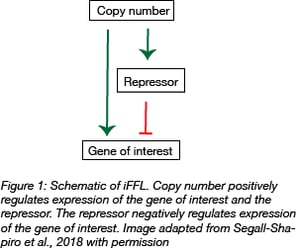
To keep gene expression stable regardless of copy number, the team made use of stabilized promoters. In contrast to unregulated promoters that are always on, stabilized promoters incorporate feedback loops such as the incoherent feedforward loop (iFFL). In general, iFFLs use an input signal that both positively and negatively controls the output. In this case, plasmid copy number is the input and gene expression is the output.

The input, plasmid copy number, directly influences gene expression. By itself, increasing the copy number of a gene increases its expression. However, if you introduce negative regulation by using a promoter that is responsive to a repressor protein, the increase in expression due to copy number is kept in check. In such an iFFL, as plasmid copy number increases, the amount of repressor protein also increases thereby intensifying repression of the gene of interest and keeping its expression level constant.
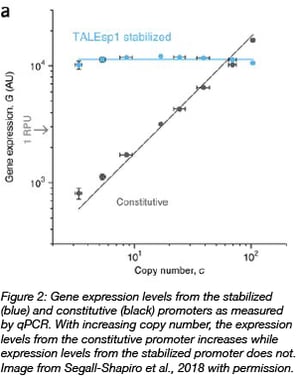
Figure_2A-01-1
In the case of the stabilized promoters from Segall-Shapiro et al., they chose a TALE protein as the repressor because TALEs can be programmed to bind tightly to arbitrary DNA sequences and have been shown to achieve ~100 fold repression in Ecoli. In addition, TALEs bind non-cooperatively to the promoter region, which is predicted to be required to decouple gene expression and plasmid number.

In a suite of plasmids modified from pSC101 with copy numbers ranging from 3-100 per cell, a stabilized promoter buffered against the effects of copy number on reporter gene expression. On the other hand, using a constitutive promoter in the same background resulted in a 20-fold variation of gene expression.
Because pSC101 is not representative of all types of plasmids, the stabilized promoters were also tested in different plasmid backbones that varied in size or carried different genes. In these cases, gene expression also remained stable regardless of plasmid copy number.

Stable gene expression whether growing slowly or quickly

Growth media and growth stage can both affect gene copy number. Moreover, gene copy number is affected differently by growth rates when a gene is expressed from a plasmid as opposed to the chromosome. Let’s take a look at how the stabilized promoters perform during these types of fluctuations.
When cells are dividing rapidly, multiple rounds of replication are initiated before the cell has divided. This means that genes located near the origin will be over-represented compared to those further away. While constitutive promoters drove maximal gene expression near genomic origins of replication, the stabilized promoters created by Segall-Shapiro et al. showed nearly no position-dependent differences in gene expression.
On the other hand, slow growth can also cause changes in plasmid copy number. During the shift from exponential to stationary phase, the number of plasmids per cell increases 4-5 fold (for pUC plasmids) or ~2 fold (for p15a, R6K, and ColE2 plasmids) as cell division slows (Kittleson et al., 2011). Segall-Shapiro et al. showed that the stabilized promoters were able to better modulate gene expression during shifts in growth rate as compared to a constitutive promoter.
To simulate the increase in plasmid copy number during the transition to stationary phase, Segall-Shapiro et al. placed a trans-acting RepA protein under the control of IPTG. Because RepA is a plasmid replication initiator protein, they could alter copy number of the plasmid by altering IPTG concentrations. Higher IPTG concentration leads to higher RepA expression which results in high plasmid copy number. When they increased concentrations of IPTG, a constitutive promoter upstream of GFP increased expression of GFP six-fold, but a stabilized promoter increased expression only two fold. Moreover, gene expression levels returned to the baseline after 3 hours with the stabilized promoter while gene expression from the constitutive promoter did not.

Similar levels of expression between a plasmid and the chromosome

The team also showed that the levels of gene expression from stabilized promoters were equivalent whether the genes were expressed from the genome or a plasmid. Thus, a stabilized promoter can allow a system to be moved from a plasmid to the genome without greatly impacting the level of gene expression.
For example, the synthesis of deoxychromoviridans requires three genes whose proteins are needed sequentially. When Segall-Shapiro et al. placed the genes under the control of a constitutive promoter and then moved them into the genome, deoxychromoviridans production titers decreased. But when the genes were placed under the control of a stabilized promoter, deoxychromoviridans titers were similar regardless of where the genes were expressed.

What’s the use of stable gene expression?

Constant gene expression can enable more confidence in gene expression readouts from assays such as qPCR or microarray. But, aside from facilitating the joys of a p-value < 0.05, having such fine control of gene expression is useful for many metabolic engineering and synthetic biology goals. In metabolic engineering, the expression of enzymes in a pathway will ideally be optimized to promote generation of the desired product while avoiding the accumulation of toxic intermediates or the shuttling of the intermediates into other pathways. In cases where a specific ratio of products is needed, such as within a multi-protein complex, stabilized promoters can eliminate variability between the different components. When your pathway needs precise fine-tuning of gene expression levels, give these stabilized promoters a try.

Sunday, March 17, 2019

The CRISPR babies saga shows the need for action, not more delays

On November 25, the MIT Technology Review dropped a bombshell report. A scientist working in China was using CRISPR/Cas9 in an attempt to create gene-edited babies. Several hours later, the scientist, Jiankiu He, confirmed that two such edited babies were born in a twin live birth several weeks previously. While this claim has yet to be independently verified, the watching world erupted in controversy. Briefly, there are two overlapping, valid critiques being offered of He’s work:
  • CRISPR/Cas9 genome editing is not far enough along, scientifically, to be doing in humans;
  • We have not had a broad, public conversation or consensus around the ethics of genome editing.
Cas9 with gRNA-01

The overlap here is that it is unethical to use scientifically unproven technologies to edit a human embryo, or have a woman carry an edited embryo to term. (We should remember that the woman carrying these embryos is actively being experimented on, too.) However, as research published on December 13 shows us, CRISPR/Cas9 techniques are continually being refined; it is completely plausible that scientists will eventually have available genome editing techniques that are sufficiently safe to manipulate an embryo—even if it’s not necessarily via CRISPR/Cas9.
This leaves us with the second critique. Absent of a broad public consensus on genome editing, there was a generally agreed-upon international moratorium on utilizing CRISPR/Cas9 in humans. This topic was to be revisited at meetings when sufficient time, additional public fora for data review, and more lab research could be used to bring scientists and the public together to build consensus guidelines, but there was never a specific timeline for this plan—or any action to follow it. And we don’t have to look far for proof that this model of public involvement, research, and consensus can happen. We just have to look to the United Kingdom’s Nuffield Council.
While the Nuffield Council has recently published a report on the social and ethical issues of genome editing and human reproduction, the relevant document for the question of “how do we move forward” is the June 2012 report on the ethics of “Novel techniques for the prevention of mitochondrial DNA disorders.” This document is about the popular technique incorrectly known as “three-parent babies,” where fused genetic material from intended parents is “rehoused” in a separate, enucleated zygote with healthy mitochondria, with the intent to eradicate mitochondrial diseases.
The key success of the Nuffield Council’s report is that when it became clear that this assistive reproductive technique was feasible, three separate things happened nearly simultaneously:
  • The Wellcome Trust funded a center for mitochondrial research to investigate the scientific possibility, safety, and efficacy of the mtDNA transfer options being investigated;
  • A UK regulatory body tasked two separate non-governmental groups with seeking “public views on emerging IVF techniques designed to prevent the transmission of mitochondrial disease;”
  • The Nuffield Council began their research into both novel and previously established ethical issues raised around mitochondrial replacement therapies.
In other words, rather than having a meeting to agree upon a moratorium until another meeting, three branches – a private funder, government regulators, and an independent ethics council – all worked in tandem, within their respective mandates, to tackle a controversial and ethically fraught rapidly emerging technology.
We could do this for CRISPR/Cas9 – or any other germline editing technique—too.
As the Nuffield Council emphasized, the key to moving research from bench to bedside is, in addition to thorough ethical considerations, in making sure that the research has been adequately proven to be reasonably safe and effective. We do that through a standardized process of good research practice: computer simulations, in vitro research, animal models, and several stages of human clinical trials. This model also demonstrates that when we are at the point of scientifically rigorous and ethical CRISPR germline editing, we will initially limit the technology to research centers engaged in long-term, mandatory follow-ups and observational studies of the technique.
There are many things we can navel-gaze over from the last couple of weeks, including whether or not scientists can recognize so-called bad actors among them and “self-police” or whether the media and academic conference response to He created a positive feedback loop that rewarded unethical behavior (it’s hard to argue otherwise). To be sure, throughout the history of medical research, there have always been people who unethically experiment on humans, and they are not remembered kindly. However, despite many headlines questioning if He’s experiments prove otherwise, the scientific process does seem to be working.
I would argue that one of the takeaways from He and the CRISPR Babies is that the scientific process, as imperfect as it may be, does work when it is followed. He’s PCSK9 paper, though not featuring a clinical pregnancy, was rejected by at least one academic journal for exactly the critiques leveled at his CCR5 project. It was recognized as an unethical experimentation on human subjects, utilising a scientific technique not proven adequately safe or effective for use in humans.
The question we are left with is not “what is the translational pathway for CRISPR/Cas9 research” but whether or not we will stop shuffling our feet on necessary actions to review and decide on the future of genome editing technology. We must stop punting decisions on scientific, ethical, regulatory, and general public consensus to the next meeting of experts, and instead convene the necessary groups for the necessary discussions and actions now. 

Tuesday, March 12, 2019

What's the future of biotechnology?

In order to answer this, one need only look at the technologies that are presently treated as theoretically possible but difficult to implement.

Regenerative Medicine


A lot of research is moving this to fruition. Every few months, some stem cell derived organ has been grown, shown to work or implanted for the first time; lungsliverskidneystracheae are a few of a very long list. 

When this has fully matured, organ farms will be able to grow or even print any fully functional organ and have it ready for implantation in weeks. This will dramatically increase life expectancy and quality. Thousands of people dieevery year waiting for an organ donor. Even those who get the organ they need live a perilous, uncomfortable life on immunosuppressant drugs. Regenerative medicine will end this death and suffering.


Synthetic Biology


We have woken on this planet and found ourselves surrounded by intractably complex, ancient machines all buzzing away to fulfill some billion year old programming. What if we could unravel their nightmarishly unreadable code so to write new algorithms for them or dictate entirely new forms for them? What if we could even reverse engineer them in order to compile a whole new language to work with?

This is already being done in a variety of industries. We genetically engineer plants to carry vitamins or be pest resistant, so we don't need to use pesticide. Since the 1970s, the insulin we give diabetics has come from genetically modified yeast. What if we could engineer bacteria to scrub the air of our pollutants and turn them into fuel or plastics

When this is mature, we'll do more than just swapping pre-existant genes between organisms for neat combinatorial affects; we'll be working from scratch. If we come to solve the protein folding problem, we'll be able to design and mass produce novel enzymes not otherwise found in nature for any conceivable effect. We may see problems that cannot be easily solved with conventional biology and design whole new genetic languages with new base pairs and amino acids custom built to the problems of tomorrow.


Population Genomics and Gene Therapy


The cost of full genome sequencing has been falling exponentially (outpacing even Moore's law) since the 1990s. With this becoming affordable, we will be able to aggregate databases of millions of genomes and correlate them to specific disease risks.  

This will let people who've had their genome sequenced see where they stand in relation to statistical outcomes -- based on their lifestyle and genes, what are the odds of developing specific conditions. Even better, with sufficient data, we will even be able to use correlations in the data to recommend meal plans and drug treatments.

It gets better. Massive data sets like this will let us find genes in the whole of humanity that help lower the occurrence of obesity, cancer, heart disease, dementia and help raise attributes like intelligence, athleticism, even aesthetics. These are the genes we'll want to put into the rest of us.

We should expect to see genetically engineered babies long before in vivo gene therapy, as that has proven more challenging to do to an acceptable standard of safety and efficacy. There is no reason to suspect that it will not eventually be perfected, however, utilizing genetically modified viral vectors.


Iterated Embryo Selection (IES)

Imagine if you could run a successful, regimented eugenics program for 300 years, selecting who breeds with whom and ignoring any ethical objections. It's an untenable effort, but this new technique would allow it to be done in months with few of the ethical qualms. The idea is genius.

Take stem cells from as many volunteers as you like and cause them to differentiate into as many sperm and egg as you will. Fertilize the eggs with the sperm to form zygotes. Sequence the DNA of the zygotes and identify which candidate zygotes possess as much of some trait that you want to select for -- intelligence, for example. 

In in vitro fertilization (IVF), this would be where you implanted the selected zygote(s) into a prospective mother -- not in IES. Instead, take stem cells from the best zygotes and stimulate those stem cells to differentiate into sperm and egg. Fertilize the eggs with the sperm and repeat the process to your satisfaction and then implant the final zygote at the end of the iterative process into a prospective mother.

This technique will let us perform evolution in vitro by skipping the 20 years that it naturally takes for generational turnover. The effects of this can be profound. If we could correctly identify the genetic corollaries of intelligence and selected for those, we might be able to achieve gains higher than 300 IQ points in a single generation.

This may be the single most impactful technique in biotech since the polymerase chain reaction.


Biological Computing


At its core, biological systems are information systems. They store information, transmit it, code, decode, scramble it. They behave according to a complex array of logic gates, so is it any surprise that we could conceivably 
manipulate biomolecules and even whole organisms into computers?

DNA has been engineered into a high density, super low error data storage device.  Living cells can be rigged into behaving like transistors, fulfilling algorithmic routines normally only seen in computer code (IF, AND, OR statements). We can do the same thing  using enzymes or even DNA itself. 

This approach to computing has drawbacks but also benefits. Chemical pathways tend to be slow compared to silicon computing, not producing results for minutes or hours. However, biological computers have the capacity to be massively parallel, which lends itself to certain categories of computing problems. Also, cells and enzymes have their own actuators; not only can they compute a result, they can then physically move things around based on that result. We eventually want molecular scale nanobots that can assemble things for us, monitor and maintain our health, but the hardware for these poses enormous engineering hurdles. Living cells provide premade hardware; we only need to give them the right software.

Obsolescence


In biotech, we are haphazardly cobbling together an ancient technology that was never built for us. It is not designed for our ease of use or for the particular problems we face. Therefore, it will never be as efficient as something we could design ourselves if we had the means. 

As we acquire that means, biology will become irrelevant as we optimize solutions that are less inspired by nature and moreso tailor made to our needs. Robots measured in micrometers will replace the synthetic cell. Super advanced robotics will replace regenerative medicine. Artificially intelligent systems will replace neurologically intelligent systems.

No technology ever disappears (in 2015, we still use oil candles and horse drawn carriages), but technologies do become marginalized and subservient to newer, superior tools. The trappings of biotech will be no different.

Reference: https://www.quora.com/Whats-the-future-of-biotechnology

Monday, March 11, 2019

Scientists Thread A Nano-Needle To Modify The Genes Of Plants


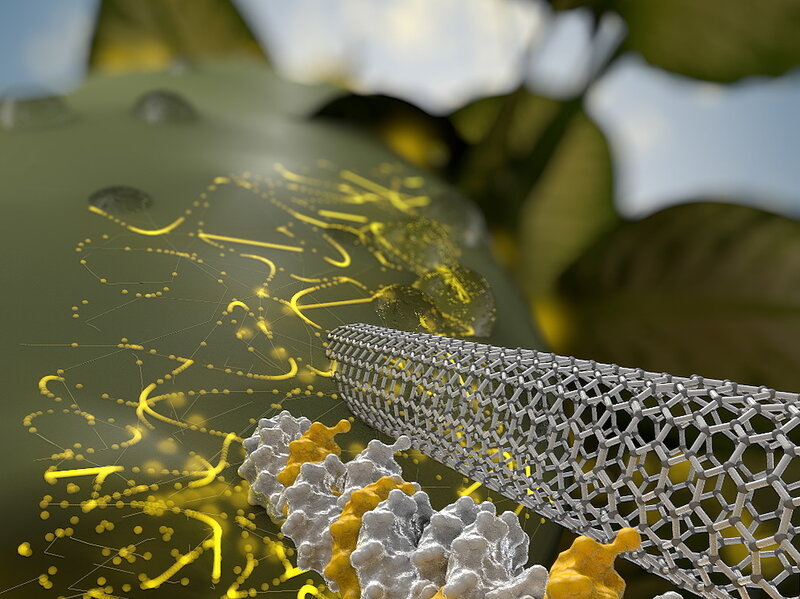
An artist's rendering shows a needle-like carbon nanotube delivering DNA through the wall of a plant cell. It also may be possible to use this method inject a gene editing tool called CRISPR to alter a plant's characteristics for breeding.
Courtesy of Markita del Carpio Landry
Is there an efficient way to tinker with the genes of plants? Being able to do that would make breeding new varieties of crop plants faster and easier, but figuring out exactly how to do it has stumped plant scientists for decades.
Now researchers may have cracked it.
Modifying the genetics of a plant requires getting DNA into its cells. That's fairly easy to do with animal cells, but with plants it's a different matter.
"Plants have not just a cell membrane, but also a cell wall," says Markita Landry, assistant professor of chemical and biomolecular engineering at the University of California, Berkeley.
Scientists have tried different ways to get DNA and other important biological molecules through the cell wall – by shooting microscopic gold bullets coated with DNA into the cell using a gene gun or by hiding DNA inside bacteria that can infect plant cells.
Both methods have limitations. Gene guns aren't very efficient, and some plants are hard, if not impossible, to infect with bacteria.
UC Berkeley researchers have found a way to do it using something called carbon nanotubes, long stiff tubes of carbon that are really small. Landry came up with the idea, and the curious thing is she's neither a n­anotechnology engineer nor a plant biologist.
"I'm a physicist," Landry says. "When I started my lab at Berkeley two years ago, my lab was focused exclusively on imaging between cells."
Markita Landry, assistant professor of chemical and biomolecular engineering at the University of California, Berkeley, came up with the idea of using carbon nanotubes to get DNA into plant cells.
Courtesy of Marcelo Perez del Carpio
She was planning to use carbon nanotubes as kind of external scaffolding around the cells to make it easier to see what was going on between them. "This was a project that failed pretty hard and pretty quick, because instead of staying outside of the plant cells as we had presumed, these nanotubes were going straight into the cells," Landry says.
So in the spirit of corporate management gurus, she turned a problem into an opportunity.
"We flipped it around and made it a DNA delivery platform instead," she says.
A strand of DNA is small enough to slip through the plant cell wall, but it's not rigid enough. "You can kind of think of it like a floppy string," Landry says. "If you try to push a floppy string through a sponge, it's not really going to work, but if you take a solid needle and try to push it through a sponge, that will work much better."
Attaching the DNA to the carbon nanotube gives you that nano-needle.
But that DNA only affects the single cell and lasts for just a few days before it degrades. To make a permanent change, you need to affect the plant's genome using a gene editing tool such as as CRISPR.
Landry says it also might be possible to use nanotubes to deliver CRISPR. Once inside a cell, from let's say an apple tree, CRISPR could, for example, turn off a gene that causes browning in apples.
"We would end up with an apple tree whose apples don't go brown when you cut into them," Landry says.
The idea of using carbon nanotubes to get DNA into plant cells is intriguing to some scientists, but "I think they've got a little ways to go to make it really interesting," says Laura Bartley, associate professor of plant biology at the University of Oklahoma.
Bartley says it will be important to show that the method works in different varieties of plants besides the two Landry describes in a recent paper in Nature Nanotechnology:arugula and wheat. But she's impressed that the new approach appears to be able to get DNA into grass plants such as wheat.
"If it works the way they think it does, I can imagine a lot of people wanting to use that," Bartley says.
In fact, she says she's thinking about trying the invention in her work on grass plants.

Friday, March 8, 2019

What is the best DNA ancestry test one can purchase on the internet?

I think Justin Ma has given a good foundation of the correct answer already, with the comparison chart and what he wrote about both Ancestry and 23andme.

Being someone who did both test with 23andme and Family Tree DNA (Family Tree DNA - Genetic Testing for Ancestry, Family History & Genealogy) I can say that apart from the numbers of people who tested (including which tests they took, autosomal gives you relatives across all your ancestors, Y-DNA only gives it along your male line and mtDNA only along your female line) there are a couple of other factors that are very important:

- the number of relatives you get


Image result for DNA ancestry test


I've answered this for 23andme in this answer (Andreas West's answer to What is the average number of DNA relatives for a 23andMe customer?) and as all companies are applying different minimum criteria you get different number of relatives. 23andme is the middle, see above for how many you can expect. For FTNDA you get the least number of people but you're also sure that everyone is indeed family (IBD) and not just from the same population (IBS). For the difference of both please read this excellent blog: Matches - Family (IBD) vs Population (IBS)

For Genealogy, Family Trees & Family History Records at Ancestry.com you get by far the most matches but as the number of relatives that you have never changes (only the number of relatives that took a test is changing over time and yes, more relatives are born each day) a lot of the relatives that they indicate are indeed population only.

- quality of family trees and paper trail research

That is another very important point. DNA genealogy is worthless without a paper trail from research proofing it, putting names to those ancestors through which you are eventually led to a common ancestor. On the other hand paper trail research (mostly presented in family trees online or in written documentation or kept in genealogy software programs) is never 100% accurate unless proven via DNA genealogy (as there are errors and events like non paternal events - the father wasn't the one recorded).

In this category Genealogy, Family Trees & Family History Records at Ancestry.com is the clear leader as they focused exactly on that in the past. Collecting masses of sources and help people build up their family tree by researching those sources. When it comes to second place, I would give this to Family Tree DNA as they tend to have better researched family trees. Last place goes to 23andme as they have many customer who just did the test to check on their predisposition towards health risks and medicines. Thus the majority of people tested at 23andme doesn't have a family tree and their knowledge of their family usually ends at their Grandparents or one generation further, a lot is just hearsay. This is especially bad for non American, as their research (or rather the lack of it) ends still in the US and thus makes it hard for non American to connect to them (as the OP asked about Australia - another immigrant country).

Image result for DNA ancestry test

- quality of reports & tools provided

Lastly after looking at the number of people that tested (for the various tests available), the quality of their family trees (or rather the absence of them) there is the third important pillar which is what information, report and tools are provided to you by the DNA testing companies to get useful information for your ancestry search.

I've explained in great detail and with many screenshots what you can expect to get from the reports at 23andme and FTNDA in regards to your ancestry composition (Andreas West's answer to Which offers better ancestry composition estimates between FamilyTreeDNA and 23andMe, and why?). To further elaborate on this, Genealogy, Family Trees & Family History Records at Ancestry.com is right now (23/9/2014) completely missing any tool and report to tell you on which segment and chromosome your are matching someone. So you will know that you match someone but you can't find out if it's family (IBS) or population (IBS). That's basically making the results pretty useless if you stop right there. But there is a solution to this and customer of Ancestry are usually advised to export their raw DNA data to services like GedMatch (read this excellent blog article explaining what GedMatch can do for your ancestry research that all the three DNA testing companies are currently not providing - Gedmatch: a DNA geek's dream site). Usually customers are just looking then at names and locations of their matching cousins family tree and find the common ancestor this way. But even if they can (given that both of you have researched and proven your family tree until there) it's still not know through which segment and chromosome you match. That's very important as mentioned in the IBD vs IBS article and it prevents you from finding a third (and more) person that match on the exact same segment and chromosome (those making it IBD). Remember that NPE (non paternal events) can lead to you or the other person having a "wrong" surname in their family tree where you will never find the common ancestor. Also, having the segment and chromosome "painted" on to the right part of your family tree helps in narrowing where to look for the common ancestor, a tedious but again very important task.

As explained in my answer to the ancestry composition question I would rank 23andme by far above FTDNA capability in terms of reports, tools and information provided to conduct your ancestry search. Ancestry should actually almost be "disqualified" for their lack of proper tools in this category.

Though the OP was asking specifically for Australia it is important to check which country is currently being serviced in your home country. Not many qualify but apart from visiting eg the US and sending your DNA samples from your hotel address (as you need an address to receive the DNA test kit), sending it through relative in those countries there are always helpful people out there that would act as a middleman to receive the DNA kit and send it to you and vice versa.

To cut a very long story short, how do you rate which is the best service or the best DNA test for ancestry?

My answer is pretty easy, if you have the money and capability, try all three big DNA testing companies named here. Also export all raw DNA data to tools like GedMatch to get matches across different service (remember that each of these companies tests different SNP's, though the large majority tested will be the same - they also test a different amount of SNP's, so you get matches with one that isn't possible with another service).

If that's not possible and you can only do two, I would say go with FTDNA and Ancestry but you must export your raw DNA data to GetMatch (or a similar service). Why is that? Well, apart from being then able to match customers from FTNDA with customers of Ancestry (though they didn't take tests with both companies) if they uploaded their raw DNA data as well you also have the advantage that you will easily find out on which segment and chromosome you match someone (or hopefully many people). I've chosen this combination of the two as both companies have a much better and higher number of family trees researched, their customers are usually answering at a much higher rate as they are also interested in ancestry (rather than the majority of 23andme customer who won't answer at all - for me it's about 25-30% which answers).

Lastly, if you can only spend your money with one company, I would go with 23andme. Surprising, right? Well, the reason why I changed my view vs the two-companies-to-go-with answer is that you get the largest number of people that have done an autosomal test (which is all at 23andme), you get the best tools & report (by far, see my answer above for details and screenshots) and you can use all this information to build up an Excel file with info about who you match on which segment and chromosome. This will eventually lead to common ancestors when you can match another relatives family tree (something I haven't achieved despite having almost 1000 relatives in 23andme with currently 72 triangulated groups and 172 proven relatives in these triangulated groups). Again, please consider to export your raw DNA results to GedMatch to find a lot more matches from the other services.

Currently I only have one common ancestor match which is coming from a relative who also tested on FTDNA and the reason is simple. We both have large, extensively researched family trees. So yes, testing with one or all of these DNA testing companies will give you a lot of relatives (or population matches) but it doesn't help you at all if you don't do the paper trail research in parallel through sources like birth, marriage and death certificates, census, wills, deeds, family bibles and military records.

Image result for DNA ancestry test

The old rule still applies, no pain - no gain!

Disclaimer: I'm not employed or in any way affiliated with any of the companies or services mentioned in this answer. All is based on learning, reading and my own experience with 23andme and FTDNA